Friday, January 6, 2017

So Many Dinosaurs!

Hello family and friends!

We've had such a fun week back at school! I hope everyone enjoyed the winter break. The kids had so much to tell us and seemed very excited to be back. They spent a large part of Monday and Tuesday telling us all about time with family and friends, and of course all the presents they got and food they ate. We decided to spend this week wrapping up our dinosaur exploration. We didn't feel like it was concluded before break and many of the kids were still interested in learning more. They've continued to ask questions and we've been answering them through some reading and research. Just because we are moving on to something else definitely doesn't mean we're done with dinosaurs. They are quite fascinating and we'll continue to explore them and make references to them throughout the rest of the school year.

One question the kids have been asking was, how did dinosaurs become extinct? We spent some time talking about the word "theory" and what it meant. We concluded from our readings that there are two main theories as to why the dinosaurs became extinct. One theory is that a meteorite hit the Earth, causing some earthquakes and volcanoes. Of course the kids thought this idea of volcanoes was awesome! We decided it would be fun to make a little volcano of our own. We talked about the fact that volcanoes have lava inside them and with pressure and a lot of chemical reactions, the lava is forced out of the top. We decided to do a little volcano experiment to go along with this theory. We spent some time making dough to mold into a volcano. We took an empty soda bottle and, after mixing up our dough, formed a mountain of dough around our bottle. We placed it in a large pan covered in sand. Afterwards, we made our own volcano explosion! We filled the volcano with baking soda. We then poured vinegar (that we dyed red to look like lava) into the bottle and watched as lava came bubbling out of our volcano. The kids were hilarious. So much excitement!! We talked about the fact that baking soda and vinegar make a chemical reaction together that causes a lot of pressure and bubbles (kind of like a real volcano). We also had the opportunity to look at some lava glass. This is formed when magma cools very rapidly. I'm convinced that this was the highlight of their school week. It was pretty awesome!

The second main theory of dinosaur extinction is ice. We talked about the idea of the Earth becoming very cold and icing over. We discussed how this would effect all types of life, even our plants, trees, and bugs. We put some dinosaurs in ice and froze them overnight. We then let the kids use tools of their choice to excavate the dinosaurs from the ice. It was basically a wet cold mess, but they loved it! We even saw some great team work. Some kids realized that certain tools worked better than others for chopping up the ice. When they were done, they were quick to share their strategy with others who were still working. Once we got our dinosaurs out of the ice, we figured out which type they were and discussed their size and food preferences. We also discussed which tools worked, which didn't, and why we think some worked better than others. We learned that some plastic toys and sticks from our nature area were not very helpful in cracking ice. However, our wooden blocks and rocks got the job done! I wish I could have captured some of their reactions when they finally excavated their dinosaur...they were priceless!

We've had a really fun time exploring dinosaurs and we've learned a lot! For next week, we will be starting a new exploration on hibernation. The talk of snow this weekend is part of the reason this subject came up. Also, one of our students brought in a book about polar bears which ended up playing perfectly into our discussion of snow. My mom also sent me an article full of pictures of snowflakes under a microscope. We were amazed to see the differences in design and shape of all these flakes. All of these small things together got us discussing winter and the cold, which lead to us wondering about animals that live outside in these conditions. This is part of what I love about teaching 4 year olds. You never know what exploration will come up next! We're excited to see where this one takes us.

Love,
Ms. Rachael


Approaches to Learning:
  • Reason about events, relationships, and events.
  • Demonstrate growing ability to predict possible outcomes based on prior experiences and knowledge.
  • Demonstrate increasing ability to use prior knowledge to understand new experiences.
  • Try to solve problems encountered in play.
Social & Emotional:
  • Interact easily with familiar adults by engaging in conversations, responding to questions and following directions.
  • Participate in group life of class.
  • Display emerging social skills of trying to take turns and talk with others during play.
  • Develop friendship with one or two preferred children.
  • Express fears and concerns to familiar adult.
Language & Literacy:
  • .Complete a thought or idea when communicating with others.
  • Classify objects and information by observable attributes into predetermined categories.
  • Begin to use classroom resources such as books, charts, photographs and graphs to gain information about topics of interest.
  • Contribute to small group or whole class stories, rhymes or poems.
  • Begin to understand the relationship between oral language and written language.
  • Contribute to small group or whole class dictation activities.
Mathematics:
  • Sort and classify objects by one attribute.
  • Identify the positions firth through tenth using concrete objects.
  • Represent simple joining and separating situations through 4.
  • Compare sets of no more than ten objects using the terms "more than" or "same as".
  • Integrate mathematical ideas into personal representations.
  • Investigate solutions to simple problems.


Excavating dinosaurs from the ice. We are great problem solvers!...


Making our exploding volcano! We are scientist...


Fascinated by the volcano glass...


Friday, December 9, 2016

We Love Dinosaurs!

Hello family and friends!

It's been a great week in the Tzemach class! Our dinosaur exploration is in full swing and we're having a blast! We've been asking a lot of questions and doing a lot of research. We've made some pretty cool discoveries, such as learning about the world's largest known dinosaur. We've also been talking a lot about Chanukah. We'll be continuing our study of this holiday into next week as well. You may notice that we've changed out our "Jewish Studies" table. It now contains a menorah, dreidels, and a large collections of Chanukah books for the kids to read and learn more about the holiday.

All the talk of imprints last week, led us to talking about dinosaur footprints and the possible fossils these prints would make. This conversation evolved into us studying the world's biggest dinosaurs. Through our exploration we found out that the largest dinosaurs are in a group called "sauropods". These types of dinosaurs are characterized by having long tails and necks, as well as large tree-trunk size legs. We were amazed to learn that these dinosaurs dwarfed all the others...including the big T-Rex...because in the mind of a 4 year old, the T-Rex is the biggest of them all :) We made some predictions about how big we thought the largest dinosaur footprint would be. After some research we found out that the largest one recorded is over 4 feet in diameter. We decided to get some paper and make a huge dinosaur footprint that measured the same size. We then did some predicting of how many kids we thought could fit into that one dinosaur footprint. The kids also took off their shoes and compared the difference in size between their foot and the dinosaur footprint. We came to the conclusion that 9 kids could fit in that one dinosaur footprint!

One question asked at the beginning of our study was, what do dinosaurs eat? We found information about this from our books (thank you to everyone who brought in dino books for us to read!). We divided dinosaurs into 2 categories: carnivores and herbivores. We spent some time going through our books and talking about each dinosaur specifically. We focused mainly on what they ate, where the probably lived, and their size. We also pulled out some magazines and cut out different pictures of meats and plants. After cutting, we divided them into categories and then glued them to posters of the different types of dinosaurs. We learned that even though the T-Rex was the biggest meat eater, the herbivore dinosaurs were actually the biggest in size! We also learned that many of these dinosaurs were extremely smart and used a lot of skill when hunting for food. We learned that most of the plant eaters had to be larger in size so that they could eat leaves from the tops of trees. The kids even turned some lunches into discussions of whether they were having a carnivore or herbivore lunch day!

Throughout the week, we've been discussing the word "archeologist". To become archeologist ourselves, we did some research on bones and skeletons. We read some boks about how archeologist uncover these bones and how they piece them together. During center time, we made an archeologist station available for the kids. We laid out some recycled pieces from our creation station and even some items from nature. We encouraged the kids to use these pieces to form their own dinosaur skeletons. We let the kids make the dinosaur skeletons however they chose to make it. We did lay out some books for them to thumb through as they chose which dinosaur they wanted to represent. I love how these turned out! This led to discussions about how many bones a dinosaur actually had. After some research we discovered that the T-Rex had around 200 bones! You can find these skeleton creations in the hallway on our bulletin board.

We're excited to see where our exploration takes us next week!

Love,
Ms. Rachael
 
 
Approaches to Learning:
  • Reason about events, relationships, and events.
  • Demonstrate growing ability to predict possible outcomes based on prior experiences and knowledge.
  • Demonstrate increasing ability to use prior knowledge to understand new experiences.
  • Try to solve problems encountered in play.
Social & Emotional:
  • Interact easily with familiar adults by engaging in conversations, responding to questions and following directions.
  • Participate in group life of class.
  • Display emerging social skills of trying to take turns and talk with others during play.
  • Develop friendship with one or two preferred children.
  • Express fears and concerns to familiar adult.
Language & Literacy:
  • .Complete a thought or idea when communicating with others.
  • Classify objects and information by observable attributes into predetermined categories.
  • Begin to use classroom resources such as books, charts, photographs and graphs to gain information about topics of interest.
  • Contribute to small group or whole class stories, rhymes or poems.
  • Begin to understand the relationship between oral language and written language.
  • Contribute to small group or whole class dictation activities.
Mathematics:
  • Sort and classify objects by one attribute.
  • Identify the positions firth through tenth using concrete objects.
  • Represent simple joining and separating situations through 4.
  • Compare sets of no more than ten objects using the terms "more than" or "same as".
  • Integrate mathematical ideas into personal representations.
  • Investigate solutions to simple problems.


Look how much we can fit into one dinosaur footprint!...


Studying herbivores and carnivores...


We are archeologist studying dinosaur skeletons!...


We love outside play!...


Friday, December 2, 2016

Dinosaurs...ROAR!

Hello family and friends!

It's been a great week in the Tzemach class! We've really enjoyed hearing about everyone's Thanksgiving break. It's been a great week for us to readjust and get back into the swing of things. We had a lot going on this week, including saying good bye to our Math Buddies. As you all know, the kids absolutely love Math Buddy time and we are so thankful to have had a fun semester with Rabbi Meir's students! As a fun good bye activity, the kids made play dough with their buddy using flour, salt, corn starch, oil, and paint. They had a blast! I'm sure they were very excited to show off the play dough. We also got to visit with a 1 year old goat this week. The kids enjoyed petting it and asking questions about the goat. It was a last minute activity that we didn't plan on, but definitely enjoyed!

We also started a new exploration this week...DINOSAURS! Of course the kids have been giddy about this new exploration and it was an easy transition from dirt as we talked about fossils during our dirt explorations. We started this exploration off as we always do, with a KWL chart. The kids knew a lot about dinosaurs but they also came up with some pretty awesome questions. Some questions were about specific types of dinosaurs but the majority covered the species as a whole. Throughout our study we will end up touching on both the individual types as well as the species in general. I'm excited to see what we discover!

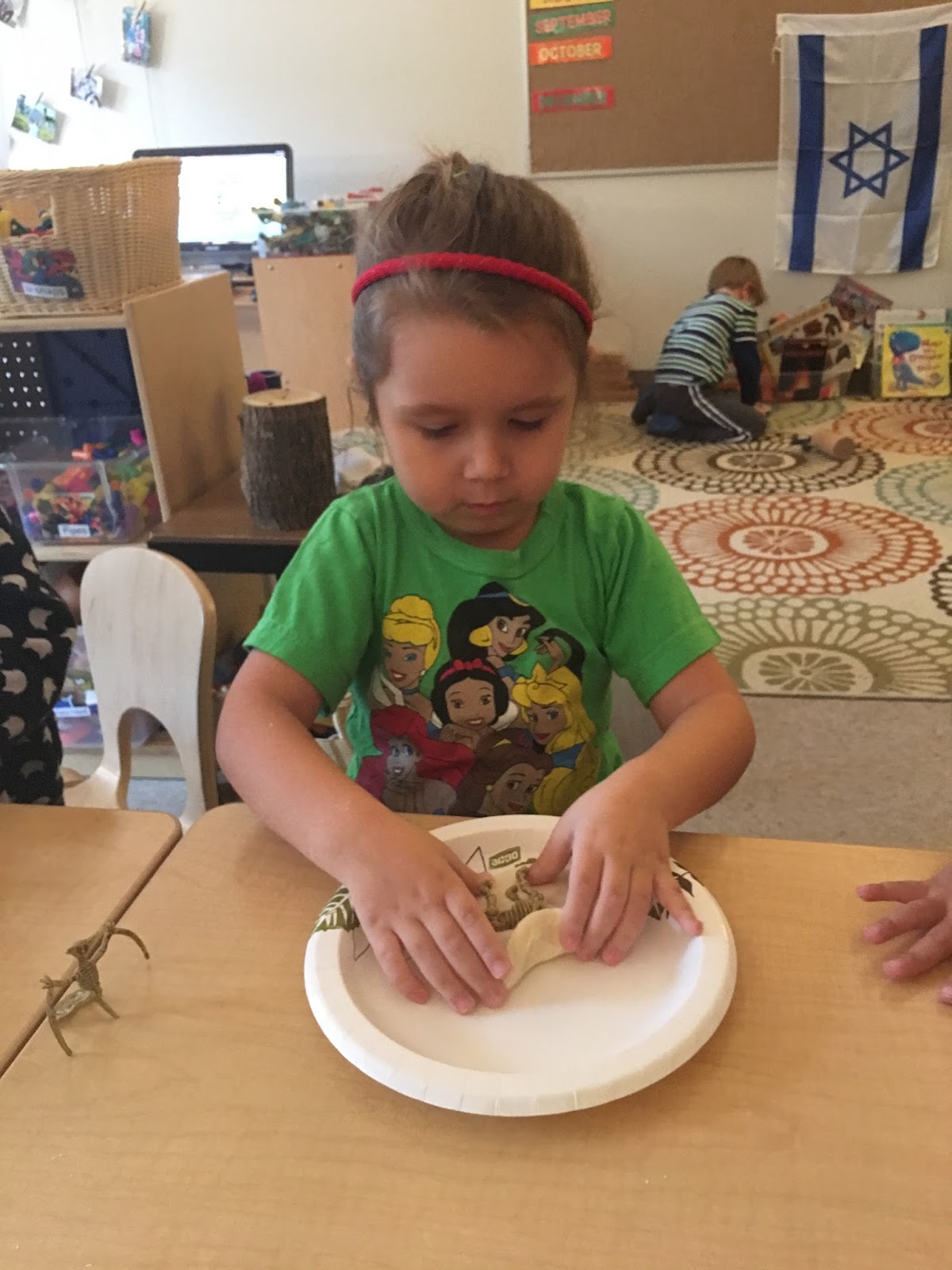
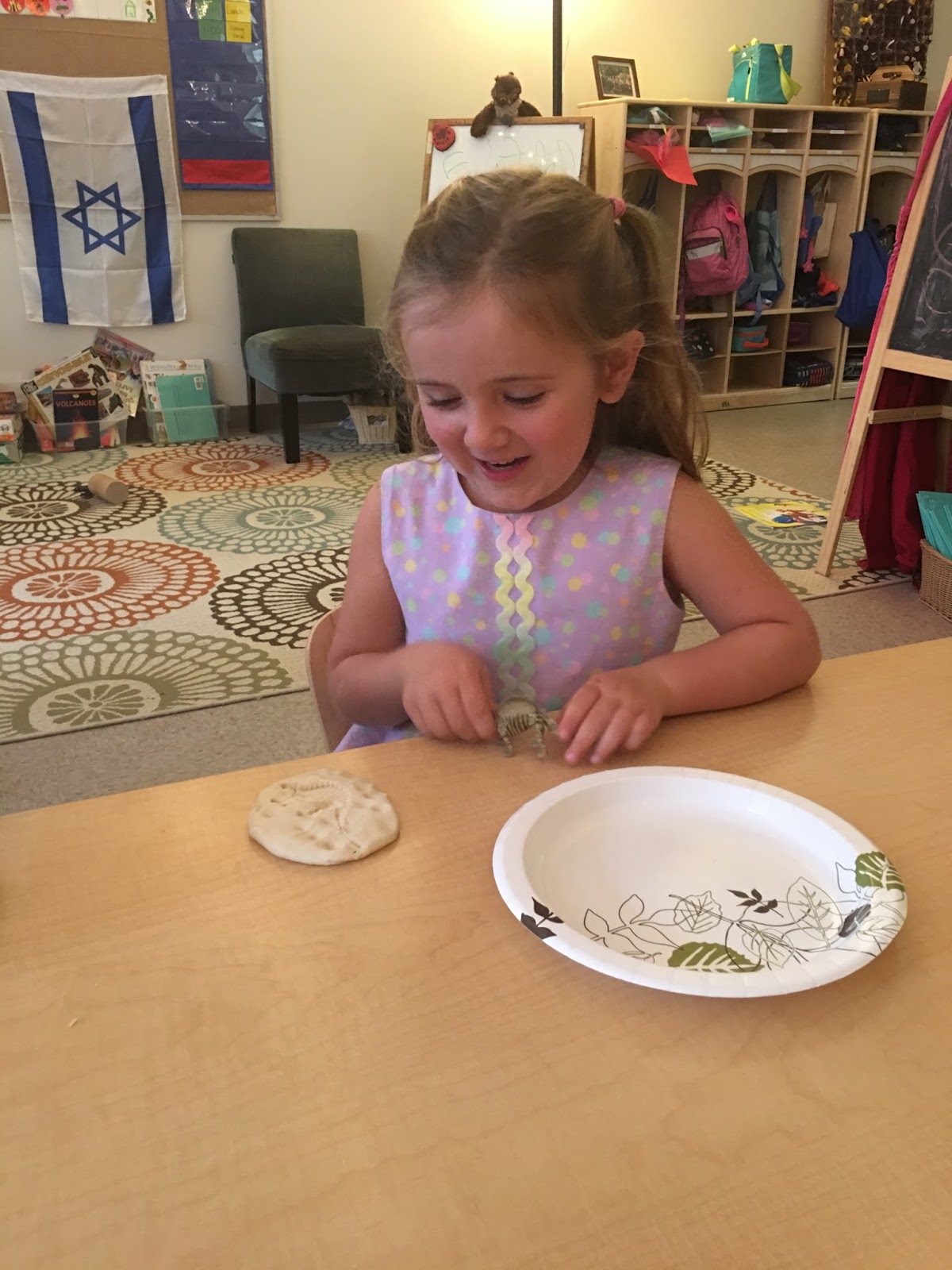
One question we had was about fossils. Using books, we were able to find out a lot of new facts about fossils. We learned that fossils were formed over a very long period of time. Throughout that length of time, the dinosaur bones actually turned into stone, which is what we know as a fossil. We also learned that fossils come in different forms. Some insects have been preserved in hard pieces of sap for thousands of years! We also learned that some fossils are actually called imprints. This is when an animal or plant leaves it's imprint in mud, which is eventually filled with sand, and finally turns into stone. We decided to make our own imprints. We have a box full of realistic miniature size dinosaur skeletons. There was a wide variety of dinosaurs so we let each child pick which dinosaur interested them the most. We then made our own salt dough and pressed the skeleton into the dough, in order to make a dinosaur imprint. We then cooked the dough until it became hard (like the imprint fossils found today). This was a great way for us to start our exploration and learn the names of some different dinosaurs. It gave the kids a lot to talk about and many more questions to ask!

After our fossil imprints were dry, we decided to do some research on our dinosaurs. We sat down one on one with the kids and talked about their fossil. After figuring out the name of our fossil's dinosaur, we looked through books to learn more about them. We let the kids search through the books to find pictures of their specific dinosaur. Once they found a page that interested them, we  read through the pages together. Our goal after reading was to have an understanding of a few interesting facts about their dinosaur. After we felt that we finished our book exploration with each child, we let them draw a picture of their dinosaur based on what they learned. The kids talked with us through their drawings, giving details about the different body parts of their dinosaur and their uses. They labeled their drawing with the dinosaur name and we asked them to share some facts they learned about their dinosaur. This will allow you can see both the dinosaur and it's skeletal imprint!

Our research on dinosaurs took a lot more time that I thought it would. The kids spent several days enjoying the books and working with their fossils. This cut out some other activities we were planning but we'd much rather take our time when they're enjoying it so much! We're excited to see where this dinosaur exploration takes us next!

Love,
Ms. Rachael


Approaches to Learning:
  • Show creativity and imagination using materials in representational play.
  • Demonstrate increasing ability to identify and take appropriate risks in order to learn and demonstrate new skills.
  • Show curiosity in an increasing variety of activities, tasks, and learning centers.
  • Demonstrate eagerness and interest as a learner by questioning and adding ideas.
  • Demonstrate growing initiative in selecting and carrying out activities.
Social & Emotional:
  • Demonstrate self direction by making choices among peers, activities and materials.
  • Demonstrate confidence by participating in most classroom activities.
  • Follow classroom rules and procedures with reminders.
  • Demonstrate with adult guidance simple techniques to solve social problems.
Language & Literacy:
  • Classify objects and information by observable attributes into predetermined categories.
  • Begin to use classroom resources such as books, charts, photographs and graphs to gain information about topics of interest.
  • Represent familiar people and experiences through art and language.
  • Combine some letters with pretend writing.
  • Begin to understand the relationship between oral language and written language.
  • Creates a picture and labels it orally.
  • Understand relationship between print and pictures on a page.
Mathematics:
  • Use nonstandard units of measure to compare everyday objects.
  • Compare the lengths of two objects.
  • Show one-to-one correspondence through ten when counting real objects.
  • Begin to show an awareness of numbers in the environment.
  • Integrate mathematical ideas into personal representations.
  • Investigate solutions to simple problems.
  • Use appropriate vocabulary to communicate mathematical idea.


Enjoying time making play dough with our Math Buddies...


Working on our fossils imprints...


Reading and researching dinosaurs!...


We got to pet a goat and learn some facts about him...