Friday, September 9, 2016

Apples, Apples, Everywhere!

Hello family and friends!

We are off to a great start with our apple exploration! We've been able to answer several of our questions and have even found new questions to ask. We were able to find tons of books about orchards, apples, honey, and honeybees at the library. That has been a great way for us to start finding some answers to our questions. These books have been used during morning meeting, small groups, reading workshop, center time, and even quiet time. As we read, we talk about new words that we've found. We also explore real apples as we read. For example, we found a book that showed us the different parts of an apple so we got one of our real apples and cut it open. We found that it matched the pictures in our books perfectly. As we did this, we were learning different parts of the apple, how they are formed, and why each part is important to the life cycle of an apple tree.

We have also been incorporating apples into the different centers of our classroom. We put some real apples in home living for the kids to use during dramatic play. We've also added some to science for the kids to dissect and explore. We added apple seeds to our art center for the kids to add to their creations and we put several in our block center, along with the book, "Ten Apples Up on Top". The kids have been using them in blocks to build structures and buildings, as well as trying to stack them like in our story.

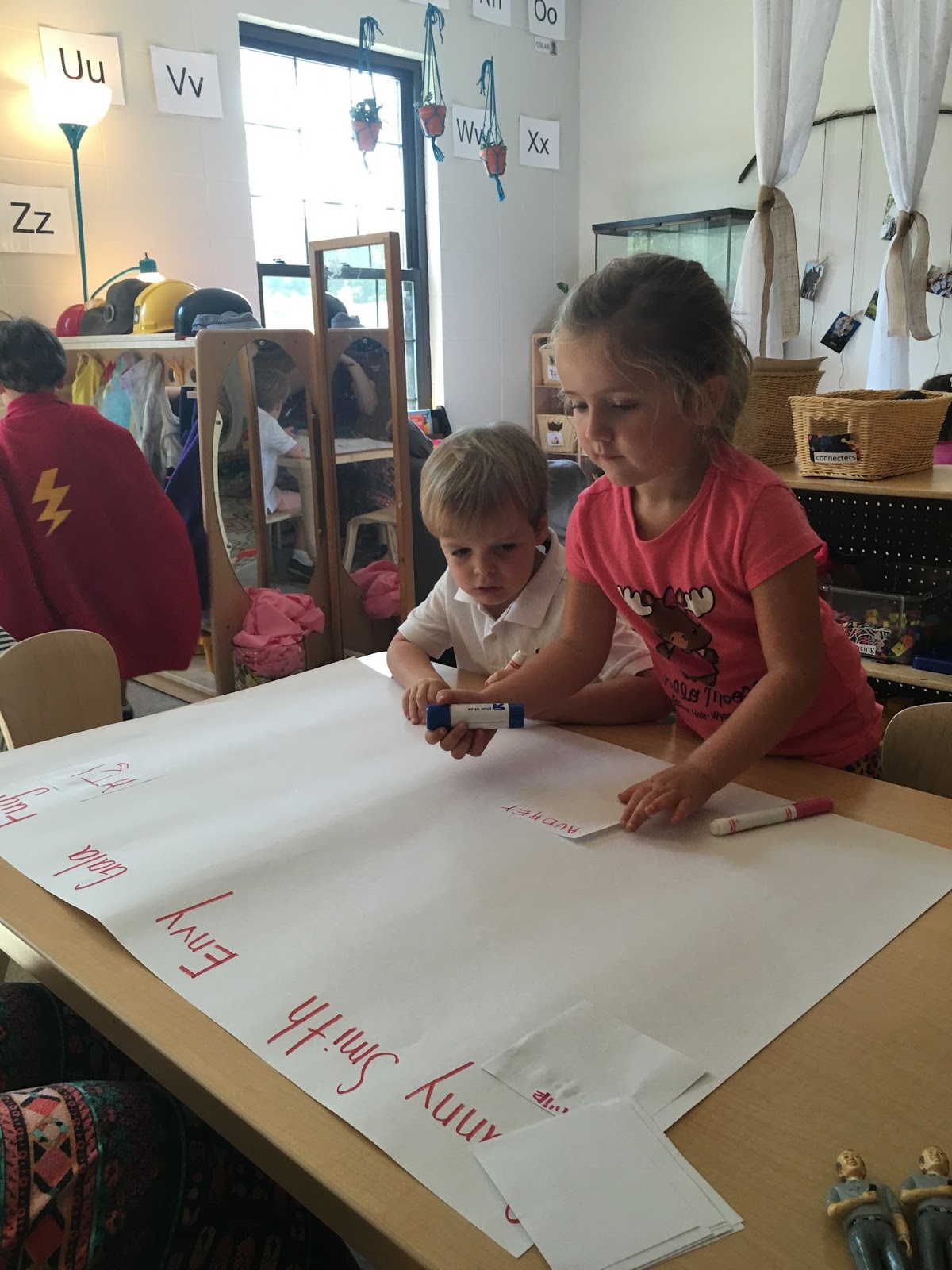
We've also been learning about the different varieties of apples. As we've been exploring them, we've noticed the difference in size and color. We've been doing a good amount of comparing and sorting. We even spent one morning trying different types of apples! We sampled Granny Smith, Gala, Fuji, and Envy apples. All of us, including me, had never even heard of or tasted an Envy apple so this was a new experience for all of us! After tasting each apple, we wrote our names on a piece of paper and glued it to chart paper under the name of the apple that we liked the most. After our chart was complete, we counted and totaled each column and then added the numbers together to learn how many of us participated in the survey. The majority of us favored the Envy apple. It was delicious! I found them at Trader Joe's if anyone is interested in trying them. We learned that they are a cross between a Gala and Baeburn apple and are from New Zealand. We also learned that this combination is what gives them their yellow and red colors.

We also became builders and engineers this week! We used toothpicks and chunks of apples to create whatever we wanted to make. As the kids made these structures, they were counting and problem solving. Many discovered that they could make shapes and letters with their pieces. As they made these shapes, they learned that a triangle can stand upright much better than a square, as the squares always seemed to collapse. This taught us one of the basic structural concepts of engineering. They were also working on their fine motor skills as they fit the small pieces together and worked the toothpicks to make their structures sturdy. As the kids worked, Michelle and I sat with them to see them work through the process. We took notes on our conversations with them as well as the process of completing their structures. This activity, along with a conversation with Ms. Kelly, has really got me interested in making a "tinkering" station for the kids. This would be an area full of loose parts and opportunities for imagination to run wild. Kids are natural inventors and scientists and explorers. This would be a great way to let them express these traits. I'm currently reading some books and doing research on the topic, so I'll keep you posted on this idea in a future blog post!

We also did a science experiment this week. During our taste testing we noticed that our apples were during brown quickly. Many of the kids were hesitant to eat these "brown" and "rotten" apples. We talked about the effect of oxygen meeting the apple skin and causing it to turn a brownish color. We asked the kids if they had any ideas on how we could slow down this process and make the apples last longer. They had some great suggestions for us to try! They suggested leaving the apple in the fridge, putting it in a bowl of water, covering it in plastic, wrapping it in a dry paper towel, and wrapping it in a wet paper towel. After we wrote down our suggestions, we made a hypothesis on what we thought would work best. We let the kids set up these different suggestions and we left the apple slices in our science area to be observed throughout the day.  At the end of the day, we met together and discussed the results. We compared each apple slice and found that the one wrapped in a wet paper towel had the least amount of brown. This has really gotten the kids excited about science experiments so we can't wait to try some more in the weeks ahead.

As we've been researching orchards, we've learned about the importance of honeybees to apple trees. This has gotten us talking more about honey, so we will be incorporating those ideas into our exploration next week. We've been having a blast exploring and playing!

Love,
Ms. Rachael

Approaches to Learning
  • Reason about events, relationships, or problems.
  • Demonstrate growing ability to predict possible outcomes based on prior experiences and knowledge.
  • Demonstrate increasing ability to use prior knowledge to understand new experiences.
  • Represent prior events and personal experiences in one or more ways.
Social & Emotional
  • Interact easily with familiar adults by engaging in conversations, responding to questions and following directions.
  • Participate in group life of class.
  • Demonstrate strategies to join play group with adult support.
  • Display emerging social skills of trying to take turns and talk with others during play.
Language and Literacy
  • Explore books independently.
  • Begin to distinguish between real and make-believe in stories read aloud.
  • Begin to ask questions about the causes of events they observe or hear about in books.
  • Contribute to small group or whole class dictation activities.
  • Makes some upper case letters without regard to proportion or placement.
  • Combine some letters with pretend writing.
Mathematics
  • Organize and represent data with real objects.
  • Use nonstandard units of measure to compare everyday objects.
  • Sort and classify objects by one attribute (size, shape, or color)
  • Show awareness of growing patterns in their environment.
  • Represent simple joining and separating situations through 4.


We still look forward to our math buddies each week!...


Mmm, apple tasting (and charting our thoughts)...


Engineers and builders hard at work...


Preparing for and checking on our science experiment...


Friday, September 2, 2016

Becoming Experts

Hello family and friends!

What a great week we've had in the Tzemach class! We've added a few new activities to our routine, as well as started our first exploration! We're only in the beginning stages of our exploration but you'll see it expand and develop throughout the next few weeks.

To start our week, we asked the kids to tell us some things that they find interesting. We wanted to know what they liked and what they were curious about. As I explained in my last post, this gives us an idea of what types of explorations the kids will enjoy this year. It also helps us have an idea of what types of books we should add to the reading center, what themed objects we should add to home living, what types of loose parts we could provide them to build with, etc. When we know the interests of each child, we can gauge our learning around it and make it more meaningful. We have our list hanging up in the classroom so we can refer to it throughout the year. As the year progresses, the kids may want to add ideas to their list. They may also change their interest and want to take an idea off of the list. We allow the list to change with the kids throughout the year. Here is a list of what everyone said...

Oscar - bucket trucks
Sylvia - otters
Yishai - horses
Sophia - kitties
Emma - frogs
Ellie - birds
Audrey - cheetahs, magnolias
Callie - pigs
Paxton - space ships
Adam - bird nests
Yael - big doll houses
Harley - princesses
Grady - dinosaurs

To pick our first exploration, we had the kids vote. We want them to learn about things that they are actually interested in. As we vote, we talk briefly about each topic. We discuss the concept of tally marks and numbers, as well as adding. We picked some options from our list of interests but also added the idea of orchards and honey. For those of you that don't know, we are about to celebrate the Jewish holiday of Rosh Hashanah. The kids have been learning a lot about this during Torah Time and have been asking questions in the classroom. Part of this holiday includes dipping apples in honey. Since several of them seemed interested, we decided to add these ideas to our list. I honestly thought they would vote on something else, but the overwhelming majority said they wanted to learn about apple orchards and honey. I'm thrilled that they picked this exploration because it will go hand in hand with the holiday coming up. We are also getting a bee hive in our school so we'll be able to have some serious hands on exploration! After we voted, we noticed that some of the kids were going around with their own list of topics and asking their peers what they wanted to learn about. We were so happy to see them expanding some of our morning meeting time during play. We'll definitely find a way to let the kids take control of the voting for our next exploration!

After the kids voted, we made a KWL chart. This is something that I do with the kids at the beginning of every exploration. To start our chart, we make a list of everything that we already know about the topic (K for know). Next, we make a list of all the questions we have about that topic (W for want to know). After the exploration is over, we will conclude by making a list of everything that we've learned (L for learn). This chart gives us a great idea of where to start with the kids. It gives us an idea of what they already know and what they are curious about. We base our exploration off of these curiosity questions and make sure we answer each one. It's always fun to pull the chart back out at the end of the exploration and see how much we've learned! Next week, we will be doing some research and experiments to start answering some of our questions. Here is a list of our K and W. As you can see, we have a lot of questions!

Know:
- There are lots of apples.
- You can dip apples in honey.
- Bees make honey.
- You pick apples at an orchard.
- Some apples grow high in the trees.

Want to know:
- Why do bees make honey?
- What different kids of apples are in the world?
- Can you make your own honey?
- What is a beehive?
- How do bees make honey?
- What is an orchard?
- How is an orchard made?
- What is the red stuff on an apple?
- How do apples get their color?
- How do apples grow?
- How do bees get honey?
- How do bees make honey?
- How do bees make hives?
- How does honey get in the hive?
- Why do apples change colors?

We also started both reading and math buddies this week! Every Monday we will meet with Ms. Kim's 4th graders. They come into our classroom and read books to us. This week our kids picked out their favorite book and got to have their new buddy read to them. It was a great experience for both sets of classes and we love the idea of joining our elementary kids with our preschoolers! We also started math buddies this week, which will happen every Wednesday. For this time, we get to meet with Rabbi Meir's college students. Each of our kids gets to partner with one of his students and work on math concepts. This week they began with playing games with the kids. Some chose to work in the classroom, some in the Kline, and others even went outside to explore math. Our kids loved it! They've been asking about math and reading buddies every day. We're so thankful that we get the opportunity to expose the kids to both of these partner times.

We also spent some time this week making gifts for our parents for Open House. We hope you enjoyed them! We had a great time speaking with everyone that night and I hope all of your questions were answers. Of course, I'm always here if you have more questions!

I hope everyone enjoys the long weekend!

Love,
Ms. Rachael


Approaches to Learning:
  • Demonstrate delight or satisfaction when completing a task, solving a problem, or making a discovery.
  • Show ability to focus attention for increasing variety of chosen tasks and activities for short periods of time (10-20 minutes).
  • Understand a task can be accomplished through several steps.
  • Reason about events, relationships, or problems. 
Social & Emotional:
  • Demonstrate confidence by participating in most classroom activities.
  • Manage transitions positively when told what to expect.
  • Display emerging social skills of trying to take turns and talk with others during play.
  • Recognize effect on others of own behavior most of the time. 
Language and Literacy:
  • Recall some details in stories read aloud.
  • Explore books independently.
  • Show interest in informational texts about familiar objects.
  • Relate information from texts to personal experience.
  • Begin to recognize similarities in sounds at the begging and ending of words. 
Mathematics:
  • Generate conjectures based on personal experiences and simple reasoning.
  • Locate patterns in the environment.
  • Count orally forward to twenty and backward from three.
  • Use appropriate vocabulary to communicate mathematical ideas.


It's pretty awesome being 4...


Enjoying books with our wonderful new reading buddies!...


Working hard on some special gifts for our families...


We met our math buddies this week!...